_-_NH_57658.jpg)
A Battleship Built for Diplomacy as Much as Battle
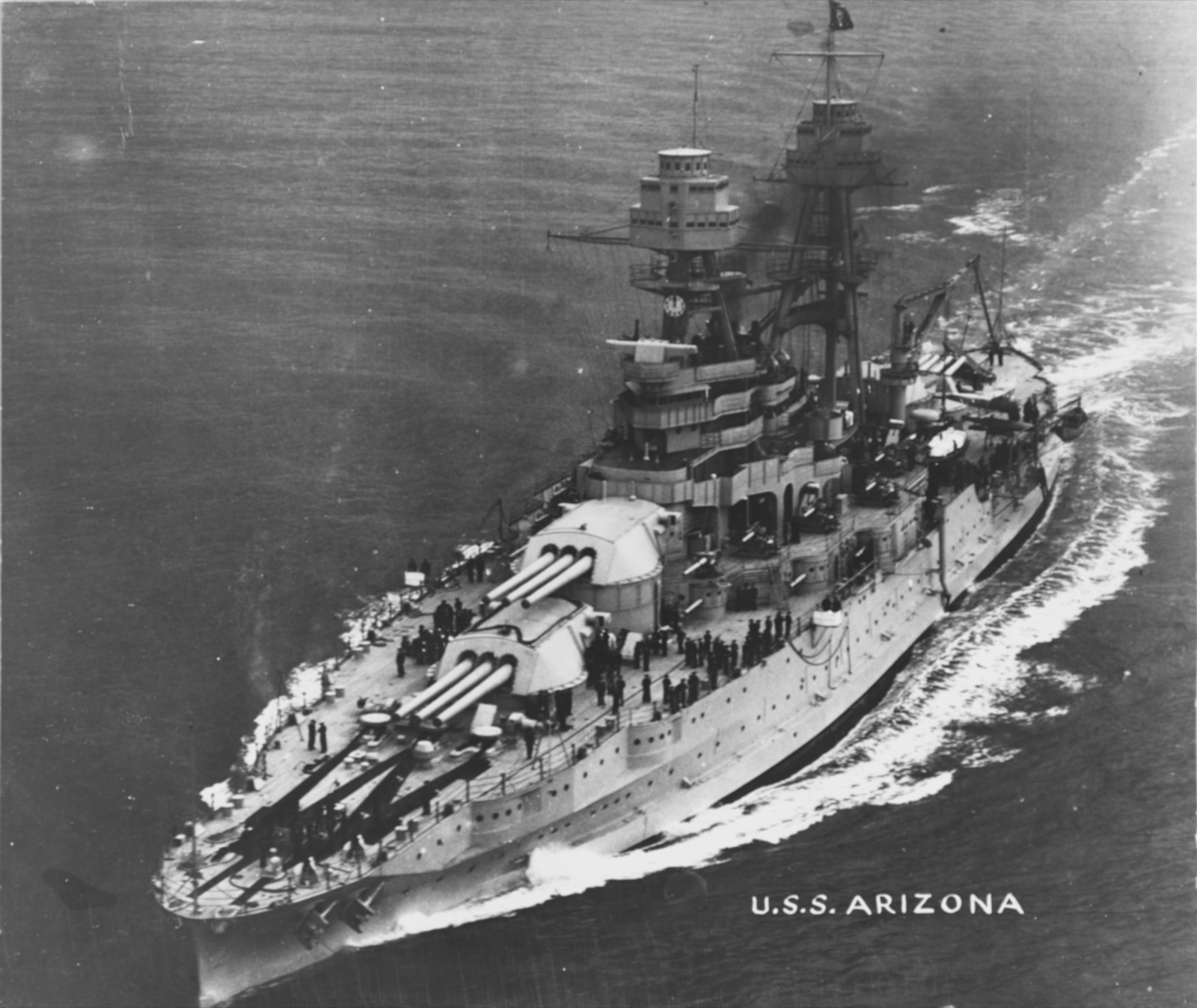
USS Arizona (BB-39) was the second and last of the Navy's Pennsylvania-class super-dreadnoughts, laid down in 1914, launched on June 19, 1915, and commissioned on October 17, 1916, about a year after the territory of Arizona itself had become the 48th state. At 608 feet long and armed with twelve 14-inch guns in four triple turrets, she was among the most powerful warships afloat when she entered service.
She never fired a shot in anger during World War I. Rather than risk an oil-fueled battleship on a submarine-infested Atlantic crossing, the Navy kept Arizona stateside as a gunnery training ship on Chesapeake Bay. Her most notable wartime duty came at the war's end: in December 1918 she escorted President Woodrow Wilson's ship toward the Paris Peace Conference, then spent early 1919 on a Mediterranean deployment, standing off the Adriatic coast during a territorial standoff between Greece and Italy to serve as a refuge for American citizens in the region.
Arizona transferred to the Pacific Fleet in 1921 and, after a 1929–1931 modernization that added anti-torpedo blisters and new boilers, spent the 1930s on training cruises and fleet exercises, including a March 1931 voyage with President Herbert Hoover aboard, photographed underway with the presidential flag flying from her mainmast. By 1940, along with the rest of the Pacific Fleet, she was based at Pearl Harbor.
Seven Seconds: How One Bomb Destroyed a Battleship
On the morning of December 7, 1941, Arizona was moored on Battleship Row along Ford Island. Quartermaster Lou Conter, then a 20-year-old sailor on the main deck, later recalled that the crew was just beginning to hoist colors around 7:55 a.m. when the first wave of Japanese aircraft appeared overhead.
At roughly 8:06 a.m., a modified 40-centimeter naval shell, converted into a 1,760-pound armor-piercing bomb, was dropped from a high-level Nakajima B5N bomber and struck the deck near Turret II. It punched through several armored decks in under a second and came to rest among the ship's forward ammunition stores, detonating moments later in an explosion so fast that a 1997 reconstruction of the event in the Naval Institute's Proceedings magazine titled it "Seven Seconds to Infamy." "There were a million pounds of powder that blew up," Conter said decades afterward. "And the bow came about 30, 40 feet out of the water, and it fell straight back down."
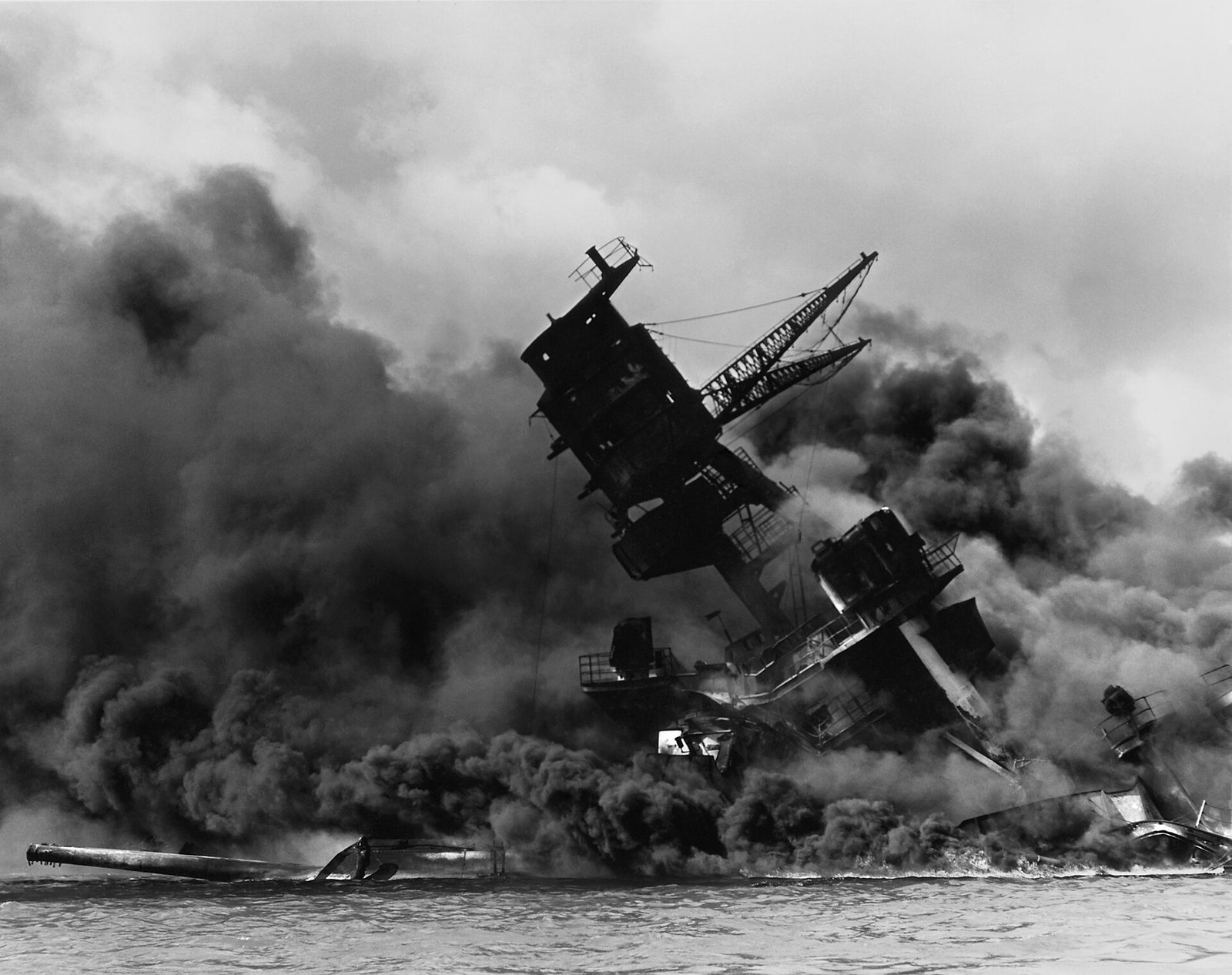
The blast tore the forward part of the ship apart, collapsed the bridge and foremast into the wreckage, and started fires that burned for two days. Arizona sank at her moorings in roughly nine minutes. "Guys were running out of the fire and trying to jump over the sides," Conter recalled. "Oil all over the sea was burning", so badly that, rather than let burned men jump into the flaming water, "we laid 15 or 16 of them down on the deck there that were coming out burned." A different battleship met an even faster end from the same kind of catastrophic magazine explosion: HMS Hood sank in roughly three minutes during its 1941 duel with the German battleship Bismarck, killing all but three of her 1,418 crew, despite a British admiral's last-minute maneuver specifically meant to protect the ship's one known weak point."
_burning_after_the_Japanese_attack_on_Pearl_Harbor_-_NARA_195617_-_Edit.jpg)
Nearly Half of All American Dead at Pearl Harbor
Of the roughly 1,512 officers and crew aboard that morning, 1,177 were killed, the single deadliest loss of life on any ship in the attack, and about 49 percent of the 2,403 American service members and civilians who died at Pearl Harbor that day. Only 334 to 335 of Arizona's crew survived the sinking.
Because the forward section of the ship was destroyed instantly and burned for days afterward, most of the dead were never recovered. More than 900 sailors and Marines remain entombed in the wreck today, joined over the following decades by dozens of shipmates who survived the attack, lived out their lives, and chose to be laid to rest with them.
The scale of the loss aboard a single ship helped make Arizona the emblem of what President Franklin Roosevelt, addressing Congress the next day, called "a date which will live in infamy", the opening line of the speech asking for a declaration of war against Japan.
A War Grave the Navy and Park Service Still Maintain
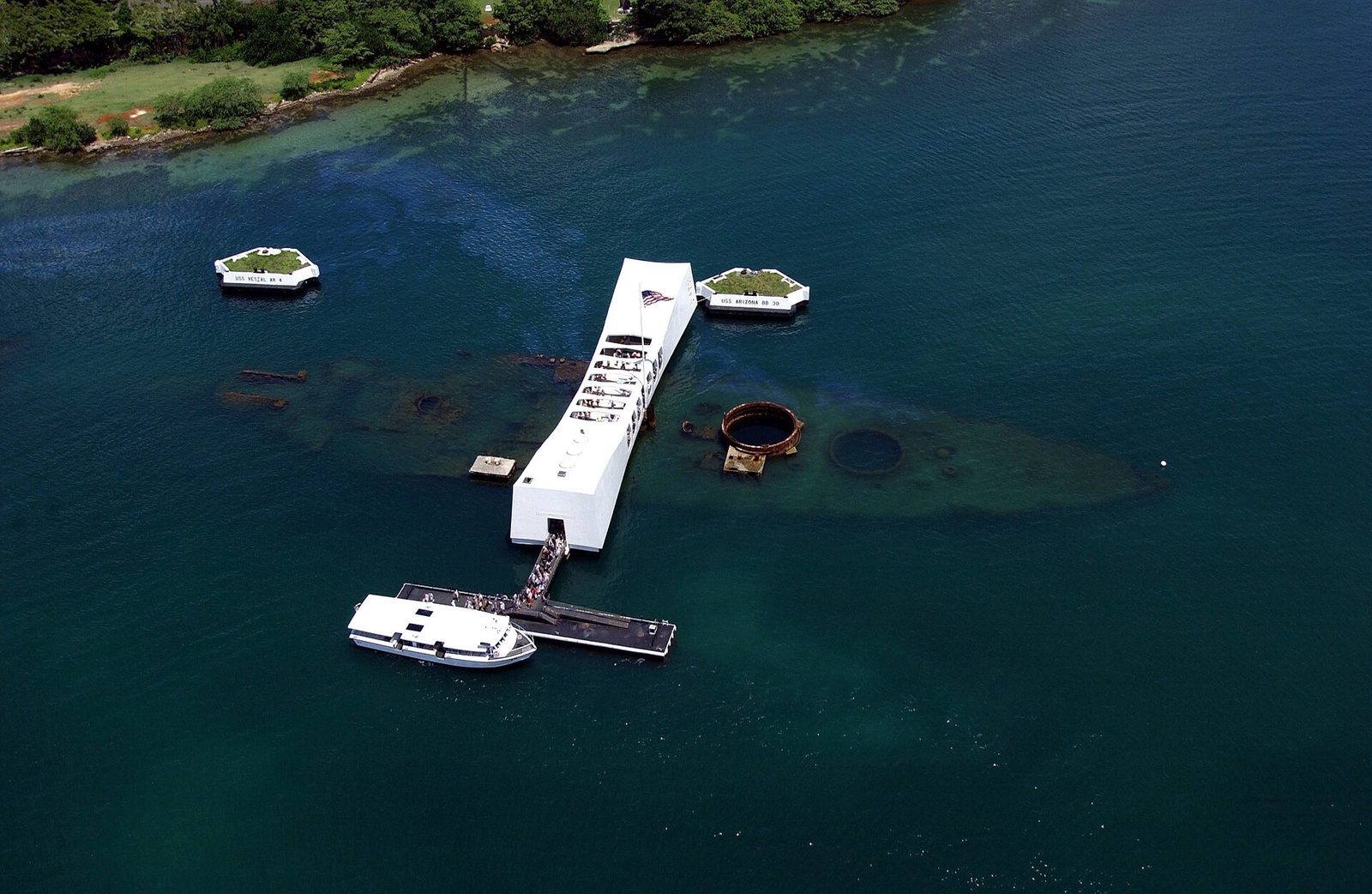
The Navy never attempted to raise Arizona; unlike several other battleships damaged or sunk that morning, she was too badly destroyed to salvage. The USS Arizona Memorial, a 184-foot white concrete structure that spans the sunken hull without touching it, was dedicated on May 30, 1962, and is jointly administered today by the National Park Service and the US Navy as part of Pearl Harbor National Memorial. An estimated 500,000 gallons of fuel oil are still believed trapped in the wreck's tanks; rather than risk disturbing it, the Navy and Park Service have left it in place, and it continues to seep into the harbor at a rate of roughly two to nine quarts a day, oil that locals and park rangers call the "black tears" of the Arizona.
The memorial is also, unusually among American war memorials, an active cemetery. Survivors of Arizona specifically, not other Pearl Harbor veterans, have the option, after death, of having their cremated remains interred inside the ship itself. Navy divers place each urn in the well of the barbette that once held gun Turret IV, reuniting each veteran with the shipmates he left behind. The National Park Service conducts a full committal service at the memorial, including a rifle salute, the playing of Taps, and a flag presentation to the family.
The program began in 1982 with Gunner's Mate Second Class Stanley Teslow, and more than 40 Arizona survivors have chosen it since. Raymond Haerry, blown into the water by the 1941 blast and later credited with helping recover his shipmates' bodies, was interred as the 42nd survivor in April 2017. "As he was getting closer to the end, I think he felt that if there's any place that he'd like to be at rest, it would be with his crewmates, the people who suffered and died on that day," his son, Raymond Haerry Jr., said at the time. Lou Conter, the sailor who recalled the explosion above, and Arizona's last living survivor, died on April 1, 2024, at age 102, closing the roster of veterans who could still choose the interment themselves. WarCrumbs' other naval-history coverage, including the USS Indianapolis and HMS Hood, is filed under the Naval History hub.
.jpg)