
A Tsar Who Learned Shipbuilding With His Own Hands
Peter's fixation on ships began in 1688, when as a teenager at the Izmailovo estate near Moscow he found an old, abandoned English sailboat in a storehouse. A Dutch merchant living in Moscow, Franz Timmermann, and a Dutch shipwright, Karsten Brandt, repaired the boat and taught Peter the basics of geometry, navigation, and sailing. Peter was reportedly amazed that the little craft could tack against the wind, and he had it rigged and sailed on nearby lakes, an experience later Russian historians treated as the origin point of his naval obsession.
That fixation became state policy in 1697, when Peter joined the Grand Embassy, a roughly 250-strong Russian diplomatic mission that toured Prussia, the Dutch Republic, England, and the Holy Roman Empire through August 1698. Peter traveled incognito under the alias "Peter Mikhailov" so he could work rather than be feted, and in the Dutch shipbuilding town of Zaandam and then at the Dutch East India Company's Amsterdam wharf, he spent months laboring as a common ship's carpenter to learn hull construction firsthand. He later had a personal seal engraved with the words "I am a pupil and need to be taught," a fair summary of the trip's purpose.
From the Netherlands, Peter crossed to England, where he based himself at Sayes Court, the Deptford estate of the diarist and naturalist John Evelyn, so he could study construction methods at the Royal Navy's Deptford Dockyard on the Thames. English shipwrights worked from mathematical draft plans rather than the more improvisational Dutch apprenticeship method Peter had just learned, and observers described the visiting "carpenter", unmistakable at roughly six feet seven inches tall, as intensely absorbed in the more systematic English approach to naval architecture.
Building a Navy From a Muddy Riverbank
The gap Peter was trying to close was not abstract. In 1695, his first siege of the Ottoman fortress of Azov, at the mouth of the Don River, failed in large part because Russia had no way to stop supplies and reinforcements reaching the fortress by water. Peter's response was to order an entire fleet built from nothing over a single winter at Voronezh, an inland town chosen for its river access, nearby timber, and iron deposits. Thousands of conscripted laborers worked alongside shipwrights recruited from Western Europe.
By the spring of 1696, the Voronezh yards had produced two warships, 24 galleys, four fireships, and well over 1,400 smaller support vessels, an improvised but functional navy that blockaded Azov from the sea and forced its surrender that July. It was, in effect, Russia's first regular navy, built in a matter of months where none had existed before.
After Russia's Baltic coastline was won from Sweden in the Great Northern War, Peter shifted shipbuilding to the new Baltic Fleet, based first at the Admiralty in his new city of St. Petersburg. By his death in 1725, sources place the Baltic Fleet at somewhere between 34 and 49 major warships (accounts vary on the precise count of ships of the line versus frigates), backed by roughly 800 galleys and smaller craft and manned by some 25,000 to 28,000 sailors, making Russia the strongest naval power in the Baltic, a region it had had no fleet on at all a generation earlier.
That fleet was not merely for show. At the Battle of Gangut in August 1714, a Russian galley force of 99 vessels carrying roughly 15,000 troops outmaneuvered a becalmed Swedish squadron off the Hanko peninsula by dragging part of the fleet overland across a narrow isthmus, then boarding and capturing ten Swedish ships, Russia's first real naval victory and proof the new navy could fight, not just exist. Peter later wrote the case for it himself: the preface to Russia's Naval Statute of 1720, drafted under his direction, argued that "every potentate that hath only land forces has one hand, but he who has a navy has both hands."
From Humiliation at Narva to a New Kind of Army
Peter's army reforms were forced on him by disaster. On November 30, 1700, a Russian force of roughly 34,000 to 40,000 men besieging the Swedish-held port of Narva was routed during a snowstorm by a relieving Swedish army of only about 8,000 to 10,000 troops under the young King Charles XII. The Swedes broke the Russian lines in close combat within hours: some 8,000 to 9,000 Russians were killed, wounded, or drowned trying to flee, and the roughly 20,000 who remained then surrendered along with the army's entire artillery train, some 177 guns. Swedish losses ran to about 2,000 killed and wounded of their own. It was a humiliating start to the Great Northern War and exposed how far Russia's old-style forces lagged behind a modern European army.
Peter rebuilt from the wreckage. He disbanded the unreliable streltsy musketeer corps, already distrusted after their 1698 rebellion, and built the new army's core around the Preobrazhensky and Semyonovsky Guards regiments. From 1699, and formalized from 1705, Russia adopted a universal conscription levy drawing on nobles and serfs alike for lifetime service, replacing the old patchwork of feudal levies with standardized Western-style training, drill, and uniforms.
The reform extended beyond the battlefield. Peter's Table of Ranks, promulgated in 1722, created a fourteen-grade hierarchy spanning military, civil, and court service in which promotion depended on merit and length of service rather than birth alone; hereditary nobility was only granted automatically from the eighth military rank upward. By the time of Peter's death in 1725, the standing army he had built numbered around 130,000 men and had reached what contemporaries judged genuinely European standards of organization and discipline.
Poltava: The Battle That Broke Sweden
After Narva, Charles XII spent most of a decade winning battles across Poland and the Baltic states before invading Russia itself in 1708. Peter's forces avoided open battle and burned crops and supplies ahead of the advancing Swedes, while a Swedish relief column carrying the invasion's supply train was destroyed at the Battle of Lesnaya in October 1708. Charles pushed south into Ukraine instead, hoping for reinforcements and support from the Cossack hetman Ivan Mazepa, and his already weakened army was further battered by one of the harshest winters in memory.
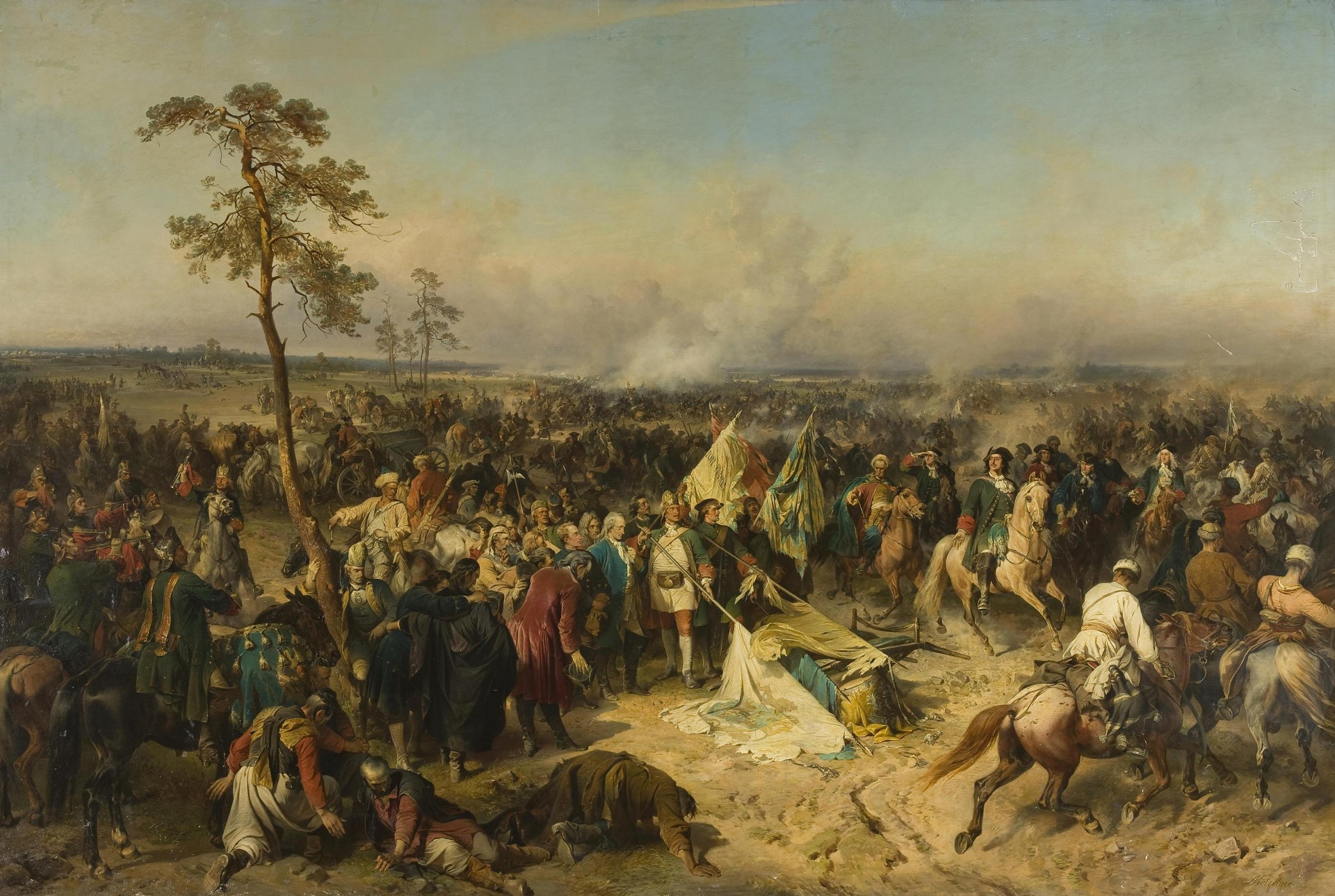
By June 1709, when the Swedes besieged the town of Poltava, Charles could field only around 17,000 to 20,000 combat-ready troops, a fraction of his original invasion force, chronically short of gunpowder and heavy artillery. Peter arrived with a relief army that most accounts put at 80,000 or more men, backed by a far larger artillery train. Peter had a line of fortified redoubts built across the likely Swedish line of advance, forcing the attacking columns to funnel through cannon and musket fire before the main battle was even joined.
When the two armies clashed on June 27 (July 8, New Style), 1709, Swedish attacks broke through in places but the army's cavalry, infantry, and artillery failed to coordinate, and Russia's overwhelming numerical and artillery advantage told over a few hours of fighting. Swedish losses in the battle itself ran to roughly 9,234 killed and wounded; days later, on July 11, the bulk of the surviving Swedish army, some 18,794 men, surrendered to pursuing Russian forces at Perevolochna on the Dnieper River. Charles XII and Mazepa escaped south with only around 1,500 men and took refuge in Ottoman territory.
Poltava is judged by historians as the decisive turning point not just of the Great Northern War but of the whole regional balance of power: it permanently broke Sweden's status as a European great power and confirmed Russia as its successor in the eastern Baltic, a verdict the war's remaining twelve years did little more than formalize.
St. Petersburg and the Peace That Sealed Russia's Rise
On May 27, 1703, in the middle of the war, Peter founded St. Petersburg on marshy land at the mouth of the Neva River, in the Baltic province of Ingria that Russian forces had just seized from Sweden. Its first structure was the Peter and Paul Fortress, built explicitly to defend the river mouth against a Swedish counterattack; before this, Russia's only significant seaport was Arkhangelsk on the White Sea, a harbor frozen for much of the year. Secure, year-round access to the Baltic was the strategic prize the entire war was being fought over, and building a naval and administrative center directly on newly won ground made that goal concrete rather than aspirational.
The city was raised largely through forced and conscripted labor at heavy human cost, and it became Russia's new capital in 1712, developing into the main base of the Admiralty shipyard and the Baltic Fleet. St. Petersburg is often described today as Peter's "window on Europe," but that phrase was not his own: it was coined by the Italian writer Francesco Algarotti in letters on Russia written in 1739 and published in 1760, and it only became famous decades after Peter's death through Alexander Pushkin's 1833 poem "The Bronze Horseman." The metaphor captures a real strategic goal, but attributing the words themselves to Peter is a later literary embellishment, not a historical quotation.
The war that began with catastrophe at Narva in 1700 formally ended with the Treaty of Nystad in 1721, under which Sweden ceded Livonia, Estonia, and Ingria to Russia. Shortly afterward, Peter adopted the title of Emperor and the Senate proclaimed Russia an empire, a status built, quite literally, on the navy, the army, and the fortress-city he had spent a quarter-century constructing from nothing.