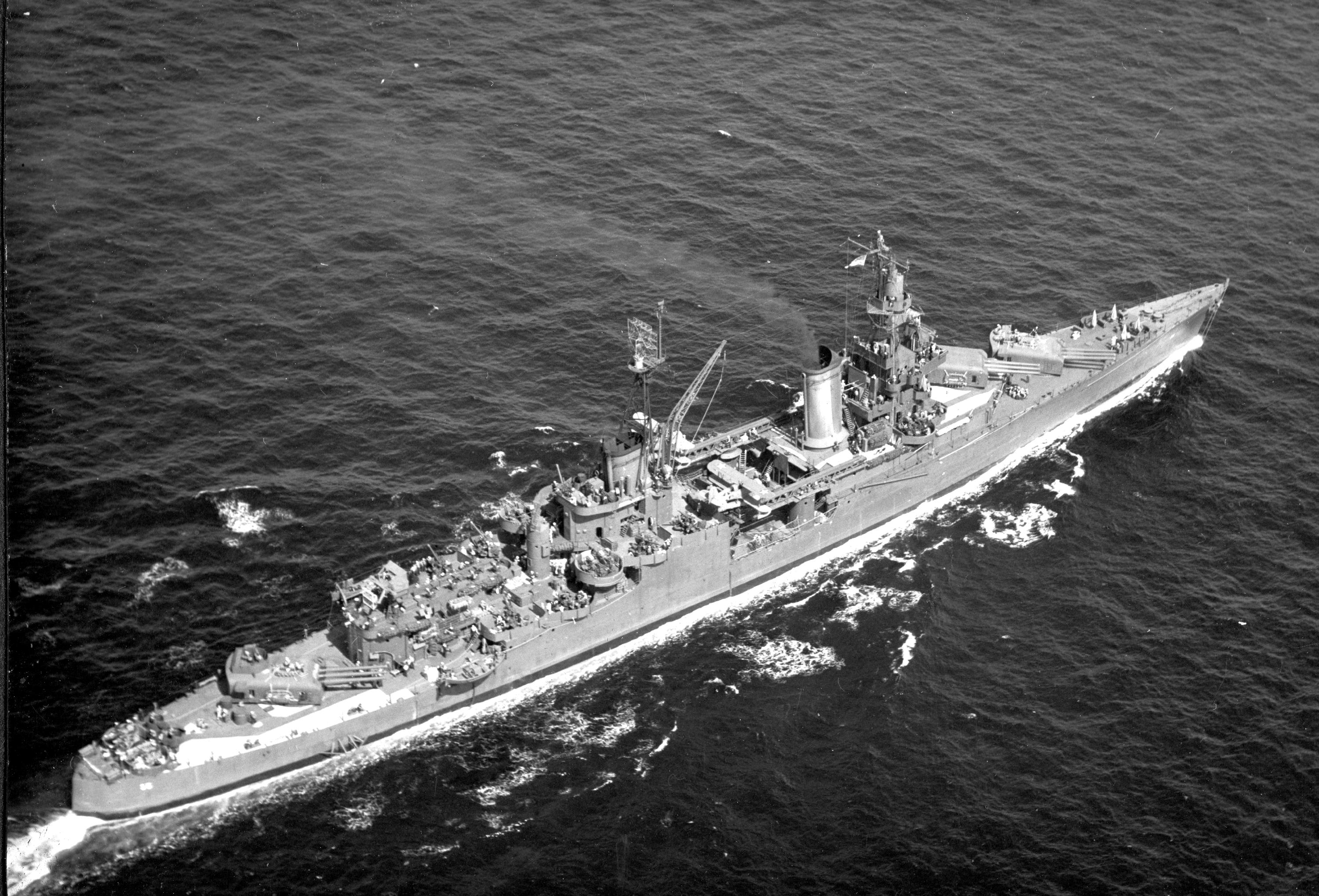
_underway_at_sea,_in_1943-1944_(NH_124466).jpg)
A Secret Cargo Bound for Tinian
On July 16, 1945, USS Indianapolis left San Francisco's Hunters Point Naval Shipyard carrying a classified cargo: components for the "Little Boy" uranium bomb, including a large share of the world's available enriched uranium-235. A lead-lined cylinder was welded to the deck of the flag lieutenant's cabin and guarded around the clock; most of the roughly 1,195 men aboard had no idea what they were transporting, only that the mission was urgent.
The ship covered the run to Pearl Harbor and on to Tinian at a pace fast enough to set a record for the route, arriving on July 26, 1945. After the cargo was unloaded, Indianapolis sailed on to Guam and then set out, unescorted, for Leyte Gulf in the Philippines to join a training squadron ahead of the planned invasion of Japan. Eleven days after the delivery, on August 6, 1945, the components she had carried were used in the atomic bombing of Hiroshima.
Torpedoed Just After Midnight
Shortly after midnight on July 30, 1945, the Japanese submarine I-58, commanded by Mochitsura Hashimoto, fired a spread of six torpedoes at Indianapolis in the Philippine Sea. Two struck, one near the bow and one amidships, igniting a fuel tank and a powder magazine. The ship rolled over and sank in about twelve minutes, too fast for most life rafts to be launched and, according to later Navy findings, too fast to get a clean, complete distress signal off the air before power failed. Another warship went down even faster for a different reason entirely: HMS Hood, her deck armor a known weakness since World War I, exploded and sank in roughly three minutes during a 1941 gun duel with Bismarck, a disaster investigators spent decades disputing before a 2001 wreck survey and a 2019 forensic reanalysis settled its cause.
Roughly 300 men went down with the ship or died in the initial explosions. The remaining crew, some 880 to 900 men, went into the water with whatever life jackets, floater nets, and small rafts they could reach, not nearly enough for that many sailors to have on hand at once.
Four Days Adrift: What Actually Killed the Men
Popular culture, largely through the shark-attack monologue in the 1975 film *Jaws*, has fixed the Indianapolis story in the public mind as history's worst mass shark attack. The documented record is more complicated. Seth Paridon, a historian formerly with the National WWII Museum who has researched the sinking extensively, put it directly: "Did they eat some of the corpses? Absolutely. Did they bite some of the survivors? For sure ... but it wasn't to the degree that the myth makes it out to be." Some survivors, including the ship's senior medical officer, reported seeing few or no sharks at all during the ordeal, while others described repeated attacks, the experience clearly varied by location in the scattered, miles-long float of survivors.
Naval History Magazine's review of the record concludes that the majority of the roughly 580 men who died after entering the water were killed by wounds from the torpedo blasts, exhaustion, and above all severe dehydration and its effects, men who drank seawater developed hypernatremia (salt poisoning), suffered hallucinations, and in some documented cases drowned or attacked other sailors they mistook, in their delirium, for the enemy. Survivor Harlan Twible, a young officer who organized a group of men to keep them together and alive, recalled the psychological toll years later: "We tried to keep the men thinking that they would be saved, but there was no way in God's green earth that I knew we were gonna be saved." Rescue did not come until August 2, when a routine Navy patrol plane happened to spot the survivors by chance, not because anyone had realized the ship was overdue.
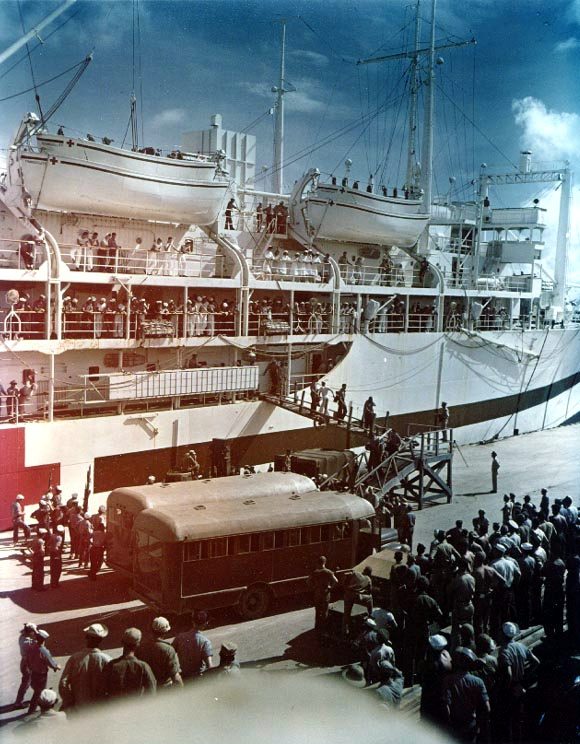
_arrive_at_Guam_in_August_1945.jpg)
The Distress Call No One Answered
For decades the Navy's public position was that Indianapolis went down too fast to send any distress signal at all. Records declassified later showed that was not true: at least three radio stations picked up SOS transmissions from the sinking ship within roughly a half hour of the torpedo strike, and none acted on them. At the naval facility in Tacloban, radioman Clair Young received the message and personally delivered it to the senior officer present, Commodore Jacob Jacobson. Young later recounted that he noticed a strong smell of alcohol in the room and suspected Jacobson had been drinking; Jacobson's recorded response was simply "no reply at this time." Aboard the harbor examination vessel LCI-1004, sailor Russell Hetz logged two SOS transmissions from Indianapolis roughly eight and a half minutes apart, but his crew judged it implausible that a heavy cruiser could sink that quickly and dismissed the calls as a possible Japanese deception. At a third station, seaman Don Allen said his commanding officer had left standing orders not to be disturbed; tugs were briefly sent to investigate on Allen's initiative before being recalled.
Separately from the missed radio calls, standing Pacific Fleet procedure at the time held that arrival reports were not required for combatant warships, only for auxiliary and cargo vessels, so no one at the Philippine Sea Frontier command was tracking whether Indianapolis had actually reached Leyte on schedule. The Navy's own court of inquiry later found that Lieutenant Stuart B. Gibson, the operations officer at Tacloban's port director office, had failed to flag that Indianapolis was overdue and had not received a new movement report; he was formally reprimanded by Fleet Admiral Chester Nimitz. Captain Charles McVay, the ship's commanding officer, was court-martialed and convicted of failing to steer an evasive zigzag course, even though I-58's own commander, Hashimoto, testified that zigzagging would not have saved the ship. On December 9, 1946, the Navy quietly remitted McVay's sentence and withdrew Gibson's letter of reprimand, without the public attention the original punishments had drawn, at the urging of Nimitz, by then Chief of Naval Operations. That step restored McVay to duty but did not clear the court-martial conviction from his record; that took another 54 years. McVay was posthumously exonerated by a joint resolution of the U.S. Congress in October 2000, after a campaign that included research by a sixth-grade student, Hunter Scott.
Finding the Wreck, 72 Years Later
Indianapolis lay undiscovered for more than seven decades. On August 19, 2017, a team funded by Microsoft co-founder Paul Allen and operating from the research vessel R/V Petrel announced they had located the wreck roughly 5,500 meters (about 18,000 feet) down in the Philippine Sea, between Guam and Palau. The team used newly available historical records, including the position of the ship that had rescued survivors, which narrowed the likely sinking location, along with autonomous and remotely operated underwater vehicles to search the sea floor and confirm the find.