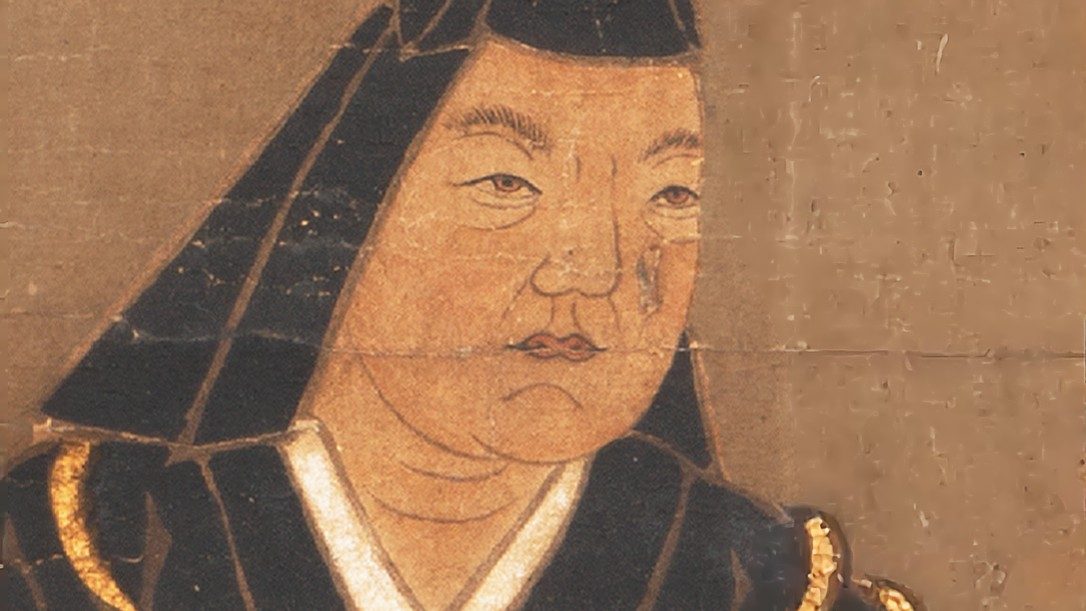

Three Strokes, Seven Marks
In September 1561 Kenshin marched out of Kasugayama Castle with about 13,000 men to fight Takeda Shingen, who arrived with roughly 16,000 and picked up around 4,000 more along the way. At the peak of the fight, the story goes, Kenshin rode alone into the Takeda command post, where Shingen sat on a camp stool. Kenshin swung a sword at him. Shingen had no time to draw his own blade and blocked with his iron war fan.
In the fuller Japanese telling, Kenshin cut three times, the second stroke wounding Shingen's arm and the third his shoulder, and the fan was later found to carry seven sword marks. That is where the scene gets its name, sandachi nanatachi, roughly "three strokes, seven blows." In the version summarized in English, a Takeda retainer named Hara Osumi-no-Kami finally speared Kenshin's horse and drove him off. A bronze statue of the moment stands at the Hachiman shrine on Hachimanbara, where Shingen's camp is said to have been.
A Chronicle Finished in 1616
The scene comes from the Kōyō Gunkan, a record of the Takeda family's campaigns compiled largely from the recollections of Shingen's retainer Kōsaka Masanobu. Wikipedia says Obata Kagenori completed it in 1616, 55 years after the battle, and a Ritsumeikan University reference dates its compilation to somewhere between the Keichō era (1596 to 1615) and the early Genna era.
The writer Kuroda Ryo, in a 2023 Diamond Online piece written after touring the battlefield, says the historical materials contain no clear evidence that the two lords fought a duel, and that for the fourth battle in general the surviving documents are so thin he calls it a "phantom battle." He adds that even the location is barely settled: of the five encounters that historians count, only the second and fourth were fought on Kawanakajima itself, and the rest took place across the wider Zenkōji plain.
Not everyone dismisses it. Historical novelist Izawa Motohiko, writing for PHP Online, concedes that historians reject the duel but calls it likely enough to be true, arguing that Kenshin believed he was the incarnation of a war god and so believed no enemy could kill him. That is an argument from temperament and adds no document.
How Many Died Depends on Who Is Counting
The same battle shows how far the numbers drift between tellers. Wikipedia's articles on the subject cite chronicle figures of 62 and 72 percent casualties for the two armies, but the two pages disagree on which side lost which: the Kawanakajima article gives Uesugi 62 and Takeda 72, while the Kenshin article gives Uesugi 72 and Takeda 62. Both mention that more conservative estimates run near 20 percent.
Izawa's account gives a very different picture. After the battle Shingen claimed to have killed 3,000 of the 13,000 Uesugi troops, roughly 23 percent, and Kenshin in turn boasted of thousands of Takeda dead. Izawa points out that a loss above 5 percent already counted as a hard fight in that era. The chronicle percentages run at roughly three times the 23 percent Shingen claimed, and nothing in the record lets a reader choose between them. Wikipedia's accounts name Shingen's younger brother Takeda Nobushige and the strategist Yamamoto Kansuke among the Takeda dead. All of these percentages come from secondary summaries, and this article did not trace them back to the chronicle text itself.
The Toilet, or the Study
Kenshin's death has its own famous image. The usual retelling has him collapsing on a latrine in spring 1578, felled by a stroke. He fell ill on the ninth day of the third month by the lunar calendar and died on the thirteenth, which Wikipedia gives as April 19, 1578. Wikipedia summarizes the Kenshin Gunki, a chronicle from 1582, as recording that "he had a stomach ache in his toilet" on the ninth, which lasted until his death on the thirteenth.
Historian Naishi Masahiko, writing in JBpress in 2021, traces the toilet to one word. The Kōyō Gunkan says Kenshin fell ill in a kansho, literally a quiet place. Naishi says an Edo-period military scholar, Usami Sadayuki, read that as a privy, and the reading spread. He notes that kansho can equally mean a private room or study, and that a chronicle of Date Masamune uses the same word for the retreat where Masamune sorted out the day's plans after meals. Naishi also reads the symptoms in the better sources as abdominal pain, and he quotes one early record that calls the illness either a stroke-like seizure or mushike, a broad term for gut pain. Wikipedia's English rendering of the 1582 chronicle says toilet, so the two accounts disagree about whether an early source supports the latrine, and this article does not settle it.
The poem survives: "Even a life-long prosperity is but one cup of sake; a life of forty-nine years is passed in a dream." Wikipedia's article names esophageal cancer, cites early complaints of chest pain "like an iron ball," and mentions a separate theory of a ninja hidden in the cesspool with a short spear. It adds that the theories are not mutually exclusive, and that the poem makes assassination less likely. Death stories drift elsewhere too, as with a pirate whose hanging first appears in print 113 years after the nearest chronicle admitted it had lost track of him.
The Heir He Never Named
Kenshin had no children of his own. He adopted two boys: his nephew Uesugi Kagekatsu, and Uesugi Kagetora, a son of the Hōjō lord Ujiyasu according to English Wikipedia (Japanese sources note that some accounts differ), taken in to secure Echigo's borders. Japanese accounts add that he left no will naming a successor. Within two months of his death the two adopted sons were at war.
Kagetora took up position at the Otate, the former residence of the Kantō deputy, while Kagekatsu held Kasugayama. Kagekatsu made peace with the Takeda (the English biography also records his marriage to a Takeda sister) and gradually gained the upper hand. Japanese Wikipedia dates the fall of the Otate to March 17, 1579, and Kagetora's suicide a week later, on March 24; English Wikipedia gives only the year. The infighting cost Echigo dearly, because the Oda armies used the years of distraction to advance to the Echigo border after taking Noto and Kaga.
Was the God of War a Woman?
One modern theory gets asked about a lot. Yagiri Tomeo proposed that Kenshin was a woman, and the idea has fed fiction ever since, including Akiko Higashimura's manga Yukibana no Tora, serialized from 2015 to 2017. When the singer Gackt played Kenshin in the 2007 NHK drama Fūrin Kazan, he has said he had this myth in mind, presenting the lord clean-shaven with long hair. It comes from fiction writing. The biographical record above says only that Kenshin had no children of his own and spent ages 7 to 14 at the Rinsen-ji temple.
The real Kenshin was born Nagao Kagetora in 1530, the third or fourth son of a lord killed in battle in 1536, and he took over the Nagao clan at 19 after his older brother stepped down. Later he was named Kantō deputy, took the name Terutora, and finally Kenshin after a vow to become a Zen Buddhist. Another samurai whose signature image postdates him by generations is the eyepatched daimyō whose nickname arrived 194 years after his death.