
A Division Mistaken for Siberian
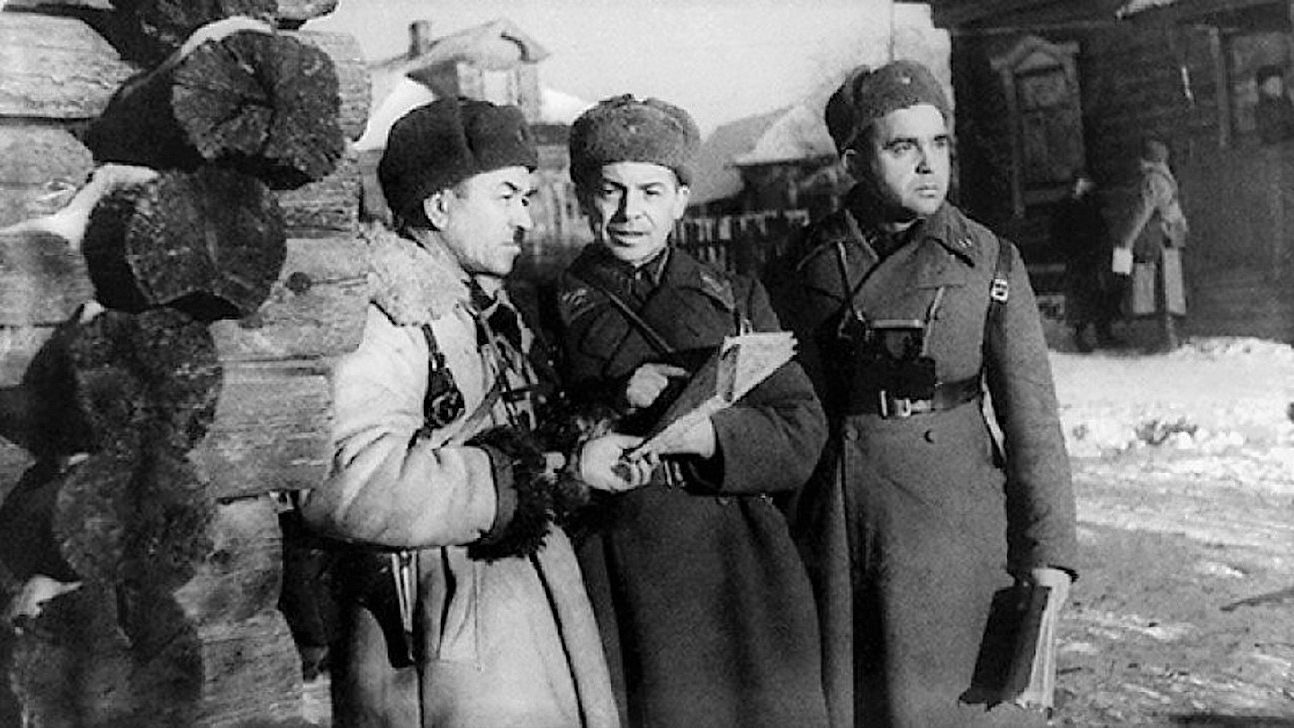
Operation Typhoon, the German drive on Moscow, opened on September 30, 1941, just over three months into the invasion that broke Hitler's non-aggression pact with Stalin, and by early December had pushed a German reconnaissance battalion to within about 30 kilometers of the Kremlin, at the town of Khimki, the closest German forces would ever get to the Soviet capital. Holding the western approach along the Volokolamsk highway was the Red Army's 316th Rifle Division, a formation recruited mostly from the Kazakh and Kirghiz Soviet Socialist Republics rather than Siberia, the region popular memory still tends to credit with saving Moscow. Its commander, Major General Ivan Panfilov, spent October fighting a costly, month-long delaying action west of Volokolamsk; Georgy Zhukov, commanding the Western Front, judged the division's performance strong enough to recommend it for Guards status and the Order of the Red Banner. Panfilov did not live to see the fighting that made his division famous: German shellfire killed him on November 18, 1941, two days after his men's most consequential engagement.
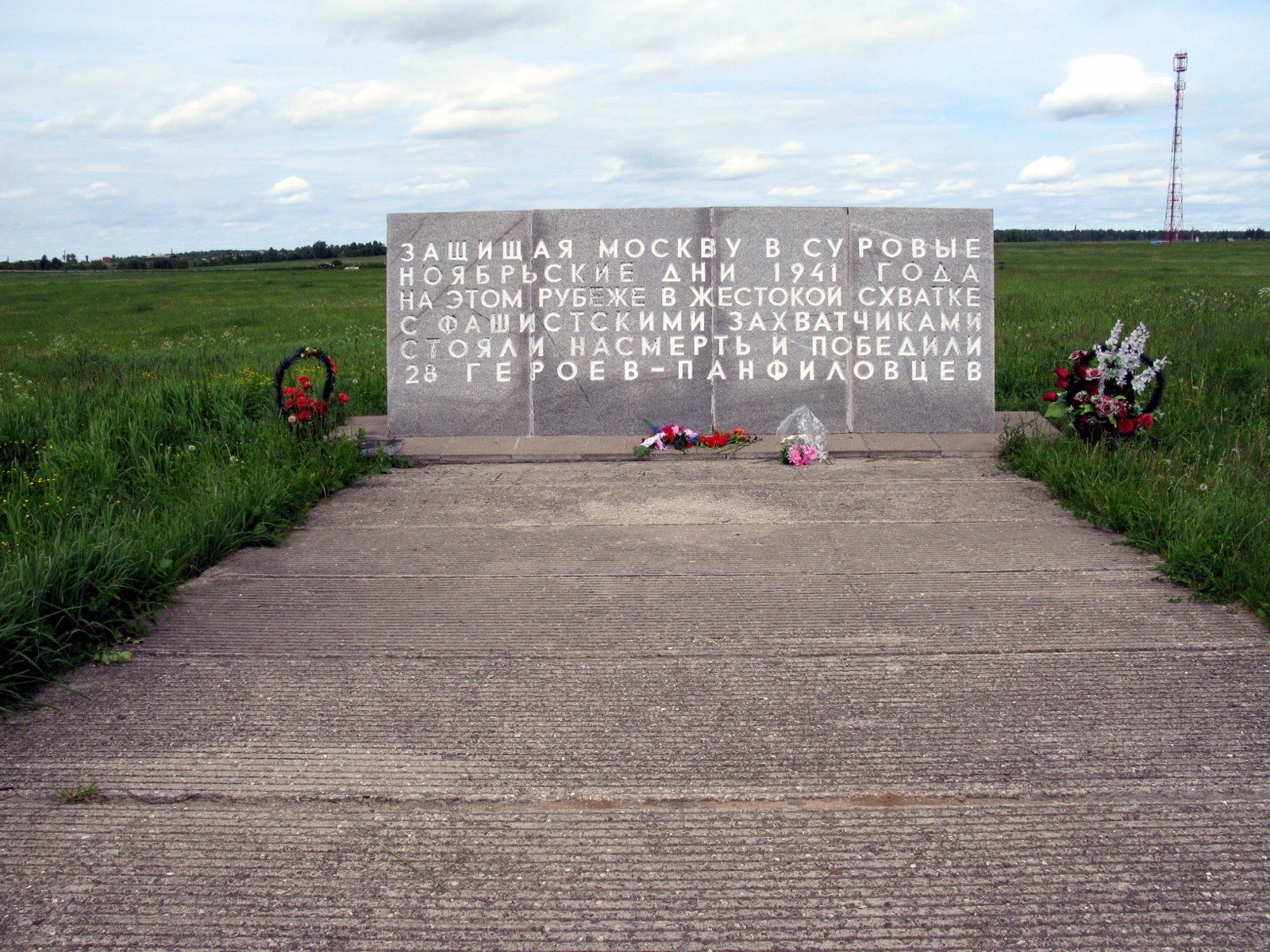
On the morning of November 16, three German panzer combat groups struck the 1075th Rifle Regiment's positions near a rail crossing called Dubosekovo. Neither side's surviving operational records describe an unusually stubborn stand there: German units reached the villages of Petelino and Nelidovo by 10 a.m. and bypassed the crossing entirely, and the regiment's commander, Colonel Ilya Kaprov, later testified only that his 4th Company took over a hundred casualties fighting German tanks and destroyed some of them. It was real fighting, on a day when Heinz Guderian's panzers, advancing on Moscow from the south, were also grinding to a halt in the mud outside Tula. What it was not, according to every document later uncovered, was the specific, named, twenty-eight-man last stand that within two weeks would become Soviet legend.

Fifty-Four Tanks Become Eighteen
On November 24, journalist Vasily Koroteev of Krasnaya Zvezda traveled to the 16th Army's headquarters to interview Konstantin Rokossovsky and there met Commissar Sergei Yegorov, the division's chief political officer. Yegorov, who admitted he had not witnessed the fighting himself, told Koroteev secondhand of a group of soldiers who had faced a column of 54 German tanks and shot two of their own men for trying to surrender. Koroteev's article, published November 27 under the headline "Panfilov's Guardsmen in the Battle for Moscow," reported the enemy had lost 800 men and 18 tanks, already a smaller number than the 54 Yegorov described, and named neither a date, a place, nor an exact number of soldiers involved.
The next day's Krasnaya Zvezda ran a front-page editorial by Aleksandr Krivitsky, "The Will of the 28 Fallen Heroes," and the number 28 entered the record almost by accident: editor David Ortenberg had asked Koroteev how many men were in the group, and Koroteev guessed roughly thirty, including two who had wanted to surrender; Ortenberg trimmed that to one and settled on twenty-eight. Krivitsky visited the division in person looking for witnesses and found none; Kaprov told him he had never heard of the action. Yet on January 22, 1942, Krivitsky published a second article supplying the missing date, the Dubosekovo location, and a hero, political officer Vasily Klochkov, whose invented last words, "Russia is a vast land, yet there is nowhere to retreat, Moscow is behind us," would be quoted in Soviet textbooks for decades. The same article claimed a dying soldier, Ivan Natarov, had described the fight from a field hospital bed; regimental combat logs later showed Natarov had been killed two days before the battle he supposedly survived to describe.
The Investigation a Collaboration Case Triggered
The story went unchallenged for six years, until the Kharkov Military Prosecutor's Office arrested a local police chief named Ivan Dobrobabin in November 1947 on suspicion of wartime collaboration. Dobrobabin, it turned out, was one of the 28 men listed as having died at Dubosekovo; he told investigators he had been captured, escaped, and then chosen to serve as police chief in German-occupied Ukraine rather than rejoin his unit. His arrest forced Soviet authorities to reopen the Dubosekovo case, and the resulting inquiry, supervised by military judge Lieutenant General Nikolai Afanasyev, went further than anyone in 1941 had intended it to.
Afanasyev's investigators found six of the "28 dead" heroes still alive: Dobrobabin himself, along with Dmitry Timofeev, Illarion Vasilyev, Grigory Shemiakin, Ivan Shadrin, and Danil Kuzhebergenov, the last of whom had been forced in 1942 to sign a confession admitting he had never fought at Dubosekovo at all, after which his name was quietly swapped in official lists for a different soldier, Askar Kuzhebergenov, who had not even joined the division until January 1942, weeks after the battle he was credited with dying in. Regimental logs placed two more of the "28," Natarov and Duishenkul Shopokov, dead on November 14, two days before the fight they were said to have died in. Krivitsky himself admitted to investigators that he had invented most of the article's specific details, Klochkov's last words and Natarov's deathbed account among them. Filed with the Soviet Procurator General on May 10, 1948 and passed on to Stalin and Politburo member Andrei Zhdanov, Afanasyev's report concluded that the last stand "did not occur. It was a pure fantasy," while the chief military prosecutor's office told Zhdanov separately that the legend "does not correspond with reality," attributing it to "the fiction of correspondent Koroteyev."
Forty-Two Years Classified, a Job Lost in Eight Months
None of it changed Soviet policy at the time. On July 21, 1942, all 28 men were posthumously awarded Hero of the Soviet Union, multi-meter statues eventually rose near Dubosekovo, and a memorial park in Almaty carried the story into the next generation of schoolbooks unchanged. When the literary magazine Novy Mir published historian V. Kardin's 1966 article raising the same doubts Afanasyev had already confirmed in secret, Soviet leader Leonid Brezhnev denounced the piece by name, calling any suggestion that "there were no 28 Panfilov men" and that Klochkov's famous appeal never happened "slanders against... the heroic history of our party and Soviet people." The Afanasyev report stayed classified through Brezhnev's tenure and beyond, declassified only in 1990 during Gorbachev's glasnost, with researchers publishing its contents the following year to little public notice.
The story became a live controversy again in July 2015, when Russian State Archive director Sergei Mironenko posted the 1948 investigation online and, on July 20, told an interviewer the Panfilov legend was a deliberate "falsification." Culture Minister Vladimir Medinsky's public response left no room for nuance: even if the story had been invented "from the start to finish," he said, it was "a sacred legend which it's simply impossible to besmirch," and "people who try to do that are total scumbags." Mironenko, who had directed the archive since 1992, was removed from his post within eight months. Medinsky was still defending the legend three years later, telling reporters in 2018 that further digging into its authenticity was "amoral." A government-backed feature film retelling the original, uninvestigated version of the story premiered in Russian theaters in November 2016.